

AI Website Translation That Doesn’t Break Layout or SEO
Scale your business globally with AI translation that protects your layouts and SEO rankings,. Implement a structured localization workflow to achieve stable, one-click multilingual rollouts without the risk of breaking components or losing search visibility.
AI website translation has changed how companies approach international growth. What used to require weeks of manual work can now be done in minutes. For teams managing multiple markets, this creates a strong incentive to accelerate multilingual rollout.
The appeal is easy to understand. One-click translation promises immediate availability of content in multiple languages, without rebuilding pages or duplicating effort. Many platforms now offer automated translation as a default feature, often positioned as a quick path to global reach.
However, production websites behave differently from static documents. Content lives inside components, layouts, and structured fields. When translation is applied without considering this structure, the result can lead to broken interfaces, inconsistent layouts, and weak SEO.
A website localization workflow addresses these risks by introducing control at each stage. Content is prepared in structured formats, translation is applied selectively, and validation happens before release. This approach allows teams to benefit from AI website translation while maintaining stability across languages.
Why AI Translation Fails on Websites
Layout Breakage Across Languages
Translation operates at the text level, while websites depend on layout constraints. This mismatch leads to visible issues once translated content is rendered.
Languages vary in length and structure. German and Finnish often expand beyond English equivalents, while shorter languages can compress meaning into fewer characters. Buttons, navigation items, and product cards are especially sensitive to these differences. Text overflow, wrapping, and truncated labels appear when components are not designed for multilingual variation.
Consistent layouts across languages require components that adapt to content length without breaking alignment or spacing. Fixed-width elements and hardcoded UI limits make this difficult, especially across responsive breakpoints.
Component-Level Issues
Modern websites rely on reusable components. These components expect structured inputs and aren't intended for raw text replacement. AI website translation often ignores this boundary.
When strings are embedded directly into templates, translation can affect logic tied to those components. Labels, placeholders, and dynamic values may lose context. A translated string might exceed expected limits or conflict with conditional rendering rules.
Component libraries that were built without multilingual support tend to fail under translation load. If a platform doesn’t have a clear separation between content and structure, translation without rebuilding pages becomes difficult to achieve.
Structured Content and CMS Limitations
A website localization workflow depends on structured content. Many CMS implementations store content in ways that are not translation-ready.
Fields may mix multiple content types, such as text combined with formatting or embedded links. Some systems rely on rich text blobs instead of discrete fields. AI website translation applied to these structures produces inconsistent results and increases the risk of broken markup.
Multilingual content management requires clearly defined fields for titles, descriptions, labels, and metadata. Without this structure, translation becomes unpredictable and difficult to validate.
SEO Damage During Translation
Search visibility depends on more than translated body text. AI website translation often skips or mishandles SEO-critical elements.
Localized SEO metadata must reflect search intent in each language. Direct translation of titles and descriptions does not guarantee relevance for local queries. Duplicate metadata across language versions creates indexing conflicts.
Internal linking also suffers. Translated pages may still point to original-language URLs, which weakens navigation signals for search engines. These issues accumulate and reduce organic performance.
When Does AI Website Translation Work?
AI website translation works when content, layout, and SEO are treated as interconnected systems. Text should exist as structured data, separate from presentation layers. Components must accept variable-length content without breaking visual consistency. Metadata requires its own localization process tied to search intent.
A stable website localization workflow introduces control at each step. Automated translation handles scalable content, while governance rules define review boundaries. Validation ensures that multilingual content management produces consistent layouts across languages and preserves SEO signals.
Governance Model: What AI Can Do vs What Needs Review
AI translation becomes reliable once responsibilities are clearly defined. Translation governance introduces boundaries that protect quality while keeping speed.
Fully Automated Content
Certain content types can move through AI website translation with minimal risk. These include structured body text, product descriptions, and repetitive catalog entries. When content lives in well-defined fields, automated processing preserves formatting and reduces manual effort.
UI elements such as labels or helper text can also be translated automatically if they are stored as independent keys. Multilingual content management benefits from this approach because updates propagate consistently across pages.
Automation works best when content is predictable, repeatable, and not tied to brand positioning or legal meaning.
Content That Requires Review
Some content requires human validation before publication. Legal disclaimers, regulatory statements, and contractual language must be reviewed to avoid compliance risks.
Brand-sensitive elements also fall into this category. Headlines, calls to action, and campaign messaging influence conversion and perception. AI output may be grammatically correct while still missing nuance or tone expectations.
Navigation labels and category names can affect both usability and SEO. These elements should be checked to maintain clarity and consistency across languages.
Translation Governance in Practice
Translation governance defines how content moves through the system. Roles and permissions determine who can approve, edit, and publish translations. This prevents unverified content from reaching production.
Version control adds another layer of safety. Teams can track changes across languages and revert updates when needed. This is especially relevant during a rollout, where multiple markets are updated in parallel.
Approval workflows align translation with business priorities. Automated content can be published quickly, while sensitive elements follow a review path. This balance allows AI translation to scale without compromising quality.

SEO Pitfalls in Localization
Search performance depends on localized signals. A website localization workflow must treat SEO elements as independent assets.
Titles and Descriptions
Localized metadata should reflect how users search in each language. Direct translation often fails to match local phrasing or keyword patterns. This reduces relevance in search results.
Each language version requires its own titles and descriptions, aligned with regional intent. Multilingual content management systems should support separate fields for these elements to avoid duplication.
Canonicals and Duplicate Content
Language variants can compete with each other if canonical rules are not defined correctly. Search engines may index the wrong version or split ranking signals across multiple pages.
A proper setup assigns canonical URLs per language and ensures that each page points to its correct equivalent. Without this, translated content risks losing visibility.
hreflang Configuration
hreflang tags signal relationships between language and regional versions. Incorrect implementation leads to mismatched results in search engines.
Each localized page must reference its alternatives accurately. Missing or inconsistent tags create confusion, especially in multi-region setups where language overlaps.
URL Structure and Internal Linking
URL strategy influences both usability and indexing. Translated slugs can improve clarity for local users, yet they require consistent mapping across the site.
Internal links should always point to the corresponding language version. Linking back to the original language weakens navigation signals and disrupts user flow.
A structured website localization workflow coordinates these elements. Localized SEO metadata, linking logic, and URL rules must develop together to maintain visibility across languages.
Playbook: “One-Click Translation + QA in 30 Minutes”
AI website translation delivers speed when supported by a structured website localization workflow. The process below outlines how teams can translate and validate content within a short cycle while maintaining control over layout, components, and SEO.
Step 1: Prepare Content Structure
Content should be separated from layout before translation begins. Each element must exist in a defined field, including headings, descriptions, labels, and metadata.
Components need to support variable text length. Flexible containers, responsive typography, and scalable spacing reduce the risk of layout breakage. This allows translation without rebuilding pages and keeps structure intact across languages.
Step 2: Run AI Website Translation
AI website translation is applied at the field level. This preserves formatting and avoids interference with HTML or component logic.
Bulk translation can be executed across pages or content groups. Systems that support one-click translation benefit from maintaining content structure during this step. Multilingual content management ensures that translated versions remain linked to the original content.
Step 3: Apply Translation Governance Rules
Translation governance determines how content moves after translation. Each field or content type is assigned a rule.
Automated publishing may apply to low-risk content such as product descriptions. Review workflows are triggered for sensitive elements such as legal text or conversion-focused messaging. These rules maintain quality while keeping the workflow efficient.
Step 4: Review Critical Content
Human review focuses on areas where nuance matters. Headlines, calls to action, and legal disclaimers are validated for clarity and accuracy.
Terminology consistency is also checked at this stage. Shared glossaries or term bases support alignment across languages and reduce variation in phrasing.
Step 5: Validate SEO Metadata
Localized metadata requires separate attention. Titles, descriptions, and keywords are adjusted to reflect local search behavior.
Each page must include correct hreflang references and canonical configuration. Internal links are verified to point to the appropriate language version. This step protects search visibility during rollout.
Step 6: Layout QA Across Languages
Visual validation confirms that translated content fits within components. Buttons, navigation, and cards are checked for overflow or truncation.
Responsive behavior is tested across devices. Consistent layouts across languages depend on this validation step, especially for languages with longer text patterns.
Step 7: Publish Controlled Multilingual Rollout
Content is released according to predefined rules. Some teams publish all languages simultaneously, while others use staged rollout per region.
Multilingual rollout benefits from monitoring after release. Early feedback highlights issues that may not appear during QA, allowing quick adjustments without disrupting the broader system.
Localization QA Checklist
☑ Text expansion does not break layout or spacing
☑ Buttons and navigation labels remain fully visible
☑ No truncated or overlapping UI text
☑ Localized SEO metadata reflects language-specific search intent
☑ hreflang tags correctly map language and region versions
☑ Canonical tags point to the correct localized page
☑ Internal links lead to the corresponding language version
☑ Legal and compliance content reviewed where required
☑ Terminology remains consistent across pages and components
☑ Mobile layouts display translated content without distortion
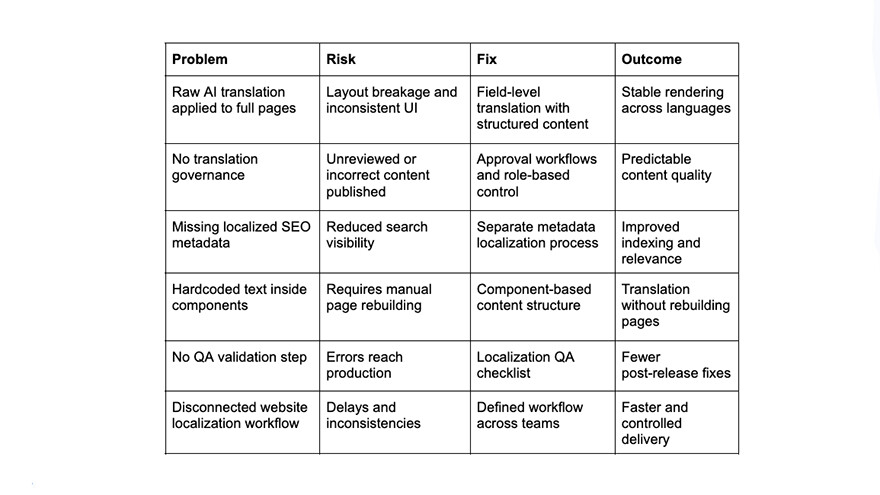
Problem → Risk → Fix → Outcome
FAQ
How accurate is AI website translation?
AI website translation produces reliable results for structured and repetitive content. Accuracy depends on context, terminology, and language pair. Human review remains necessary for legal, brand, and conversion-sensitive content.
Can AI replace human translators?
AI reduces manual workload but does not eliminate the need for review. Multilingual content management benefits from combining automation with human validation for critical elements.
How should legal disclaimers be handled?
Legal content should always pass through a review stage. Translation governance ensures that such content cannot be published automatically without validation.
What content must always be reviewed?
Headlines, calls to action, legal statements, and navigation labels require review. These elements influence user decisions and must align with brand and regulatory expectations.
Does AI website translation affect SEO rankings?
SEO impact depends on how localization is handled. Properly implemented localized SEO metadata and linking structures maintain visibility. Poor implementation can lead to indexing issues and reduced rankings.
How fast can multilingual rollout happen?
A structured website localization workflow enables translation and validation within short cycles. Speed depends on content volume, review scope, and governance rules.
How do teams maintain consistency across languages?
Consistency is achieved through shared terminology, structured content, and centralized multilingual content management. Governance rules reinforce alignment across markets.
Contact us
- Phone Number: +1 (425) 247-0867
- Email Address: [email protected]